
Leading Procurement Transformation: A Change Management Blueprint for Epicforge Rollouts
Practical guidance for bringing stakeholders, finance, IT, and suppliers along when you modernize procurement with Epicforge.

Implementing a powerful Procurement Operating System (POS) like Epicforge is an investment in technology, but its success hinges entirely on change management. A state-of-the-art AI platform is only as valuable as the organization's willingness to use it consistently.
A procurement transformation touches every part of the business—from how Finance tracks savings to how suppliers submit bids. Without a deliberate, stakeholder-focused blueprint, the initiative risks becoming a high-cost tool with low adoption.
This article provides practical guidance for leading your organization through the Epicforge rollout, ensuring smooth adoption and maximizing the return on your investment in intelligent procurement.
Making the Case for Change
Successful transformation starts with a compelling narrative that frames the move to Epicforge not as a technology upgrade, but as a crucial business necessity.
Frame the Cost of the Status Quo
To secure executive buy-in, you must quantify the pain points of your current manual processes. Use verifiable data points that directly impact the bottom line:
- Cycle Time: "Our current average Requisition-to-Order cycle time is 25 days. Epicforge will reduce this by 80%, unlocking cash flow faster."
- Leakage: "We estimate 5-7% of negotiated savings are lost due to contract non-compliance and manual errors. Epicforge's automated compliance and validation will mitigate 90% of this leakage."
- Compliance: "Manual audit preparation requires 400 hours annually. Real-time data in Epicforge makes audit readiness continuous."
Executive-Level Talking Points
Tailor your message to the specific concerns of key leaders:
| Stakeholder | Key Talking Point | Epicforge Value Proposition |
|---|---|---|
| CFO/Finance | Risk and Savings Verification. | 90% fewer manual errors means auditable, verifiable savings and zero-based budgeting alignment. |
| COO/Operations | Speed and Continuity. | 80% faster procurement cycles and proactive risk alerts ensure supply continuity and efficient resource allocation. |
| CIO/IT | Integration and Security. | Secure, cloud-native platform with easy integration into existing ERPs, reducing shadow IT and data security risks. |
Prioritize Categories for Pilot
Start where you can achieve quick, visible wins. Use a simple scoring model to prioritize categories for your initial pilot program:
$$\text{Priority Score} = (\text{Spend Value} \times 0.4) + (\text{Category Complexity} \times 0.3) + (\text{Readiness to Change} \times 0.3)$$
Target a high-spend, mid-complexity category where the existing team is eager for improvement. This ensures the pilot is high-impact but manageable.
Building the Transformation Coalition
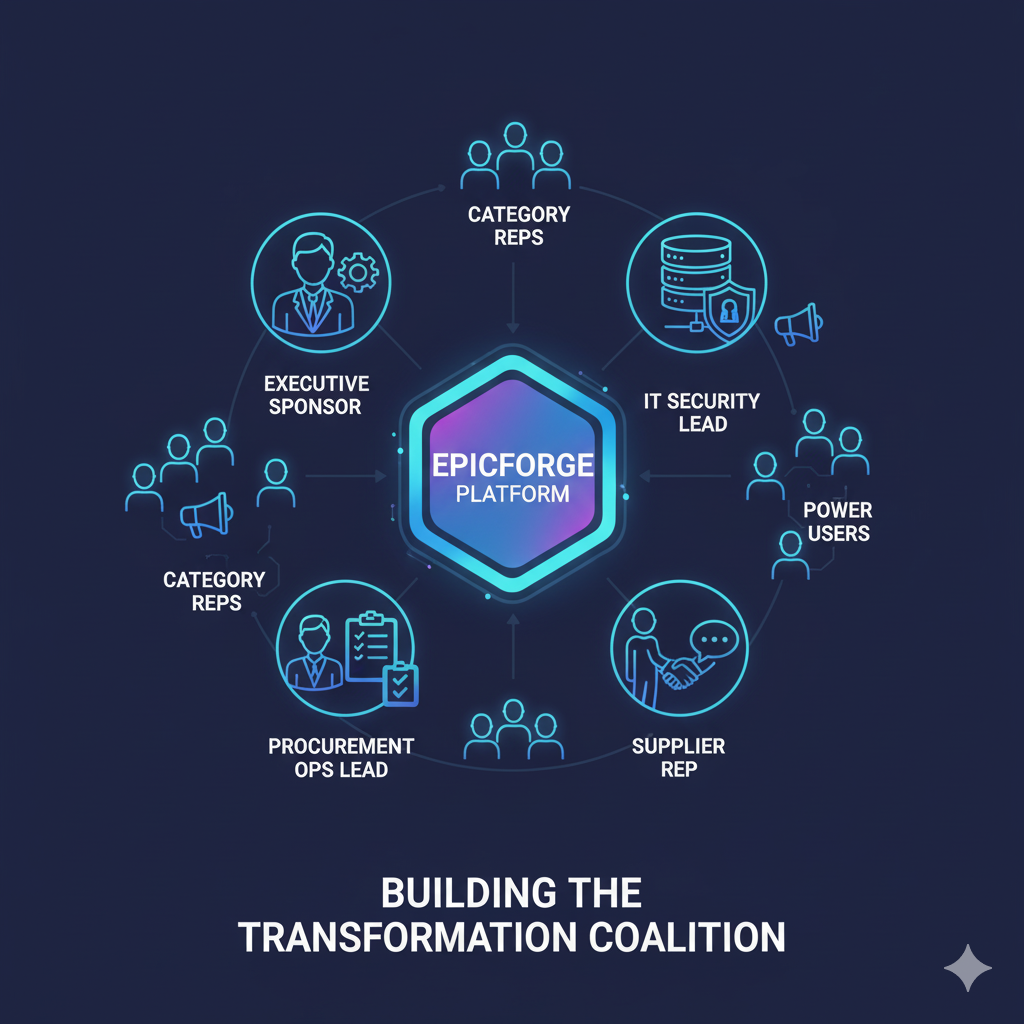
Change cannot be driven by procurement alone. You need a dedicated, cross-functional coalition to govern the rollout.
Identify Key Personas and Decision Rights
| Persona | Role in Transformation | Required Engagement Cadence |
|---|---|---|
| Executive Sponsor (e.g., CFO/COO) | Final decision-maker, budget owner, removes organizational roadblocks. | Monthly steering committee meetings. |
| Procurement Operations Lead | Day-to-day project manager, template owner, ensures data quality. | Weekly project meetings. |
| IT Security/Integration Lead | Manages ERP/system integration, ensures data security and access. | Initial setup, then monthly maintenance review. |
| Category/Business Unit Reps | Represents the 'voice of the user,' validates workflows and templates. | Bi-weekly working sessions. |
| Supplier Relationship Lead | Manages vendor communication, training, and feedback loops. | Ad-hoc during vendor onboarding phase. |
Recruiting “Power Users”
Identify enthusiastic users early in the process. These "Power Users" from various departments will be the platform evangelists. They:
- Help design user-friendly workflows.
- Test and validate training materials.
- Provide peer support and reinforce new behaviors post-launch.
Crafting the Enablement Plan
An effective rollout requires clear, consistent communication and accessible support resources.
Define the Communication Rhythm
- Before Launch (Pre-Kickoff): Focus on the Why. Communicate the business drivers, the pain points being solved, and the executive vision.
- During Launch (Go-Live): Focus on the How. Provide daily reminders, troubleshooting tips, and links to support channels.
- After Launch (Sustainment): Focus on the Results. Share early wins, usage metrics, and address common questions in a consistent forum (e.g., a monthly newsletter).
Suggest Training Assets
Cater to different learning styles:
- Live Workshops: Mandatory sessions for core procurement team to practice new workflows (e.g., RFQ creation, vendor scoring).
- Microvideos (3-5 minutes): Short, targeted videos on specific tasks (e.g., "How to Approve an Invoice in Epicforge").
- Vendor FAQs: A public knowledge base specifically addressing supplier questions about the new portal and submission standards.
- Office Hours: Dedicated time slots (e.g., twice a week for the first month) where users can drop in for one-on-one troubleshooting.
Policy and Support Templates
Ensure the process documents reflect the new system:
- Policy Updates: Revise the Procurement Policy manual to reflect mandatory use of the Epicforge system for all sourcing and vendor management activities.
- Playbooks: Update existing sourcing playbooks to include step-by-step guidance on using the platform for specific category processes.
- Support Ticket Routing: Define a clear tiered support model: Tier 1 (Power Users/Internal Help Desk), Tier 2 (Procurement Ops Team), Tier 3 (Epicforge Support).
Running the Pilot and Iterating
The pilot phase is your chance to fail small and learn fast.
Structure a High-Impact Pilot
- Clear Criteria: Define measurable start/finish criteria (e.g., "Pilot complete when 10 critical RFQs have been processed end-to-end through Epicforge, with an average cycle time reduction of 30%").
- Dedicated Team: Assign a small, focused team responsible solely for the pilot's success.
- Baseline Metrics: Before the pilot starts, capture the current baseline metrics for the chosen process (cycle time, manual effort, error rate) for comparison.
Collect Feedback Loops
Establish formalized channels for continuous feedback:
- Internal Stakeholders: Use a simple survey after key milestones ("Did the new workflow save you time? If not, why?").
- Suppliers: Include a short, optional feedback section at the end of the vendor submission process (a key factor in achieving 60% higher vendor response rates).
Prioritizing Enhancements
Use a framework like Impact vs. Effort to manage the inevitable list of requested enhancements. Only high-impact, low-effort changes should be prioritized before the full rollout to prevent scope creep.
Scaling Across Categories and Regions
Once the pilot is successful, leverage that success for broad deployment.
Sequencing Rollouts
Sequence the expansion strategically:
- Low Complexity, High Spend: Target areas where success can be replicated easily (e.g., indirect materials).
- High Complexity, High Risk: Introduce more advanced features (e.g., risk monitoring, complex direct materials RFPs) after user proficiency is established.
- Geography: Roll out to regions sequentially, leveraging the success stories and Power Users from the first region to train the next.
Adoption Tracking and Governance
- Adoption Analytics: Leverage Epicforge dashboards to track usage: login rates by department, number of RFQs initiated, contract compliance scores. Low usage in a key department signals a training or resistance issue that requires direct intervention.
- Governance Practices: Establish a standing committee to review and approve changes to templates, validation rules, and supplier classification to ensure data consistency and prevent process drift across teams and regions.
Measuring ROI and Celebrating Wins
The transformation is complete only when the new behavior is sustained and the value is proven.
Recommend KPIs for Monthly Review
- Process Efficiency: RFP Cycle Time, Contract Approval Time.
- Financial Impact: Compliance Score (contract vs. actual spend), Verified Hard Savings, Avoided Risk Costs.
- Stakeholder Experience: Internal User Satisfaction, Vendor Satisfaction (from survey data).
Storytelling Tactics
Showcasing quantifiable wins builds momentum and secures future investment:
- Board Updates: Focus on macro-level risk mitigation and verifiable cost savings (e.g., "Epicforge reduced our exposure to high-risk suppliers by 45% this quarter").
- Company-Wide Communications: Share specific stories of success (e.g., "The X team completed a major sourcing event 4 weeks ahead of schedule using the new system!").
Recognition Programs
Reinforce positive behavior. Publicly recognize the Power Users, the first team to hit 100% template compliance, or the category manager who achieved the highest verified savings using the new analytical tools. This celebration reinforces that the change is valued and permanent.

Author, Anthony Oliko
Co-Founder, Epicforge